
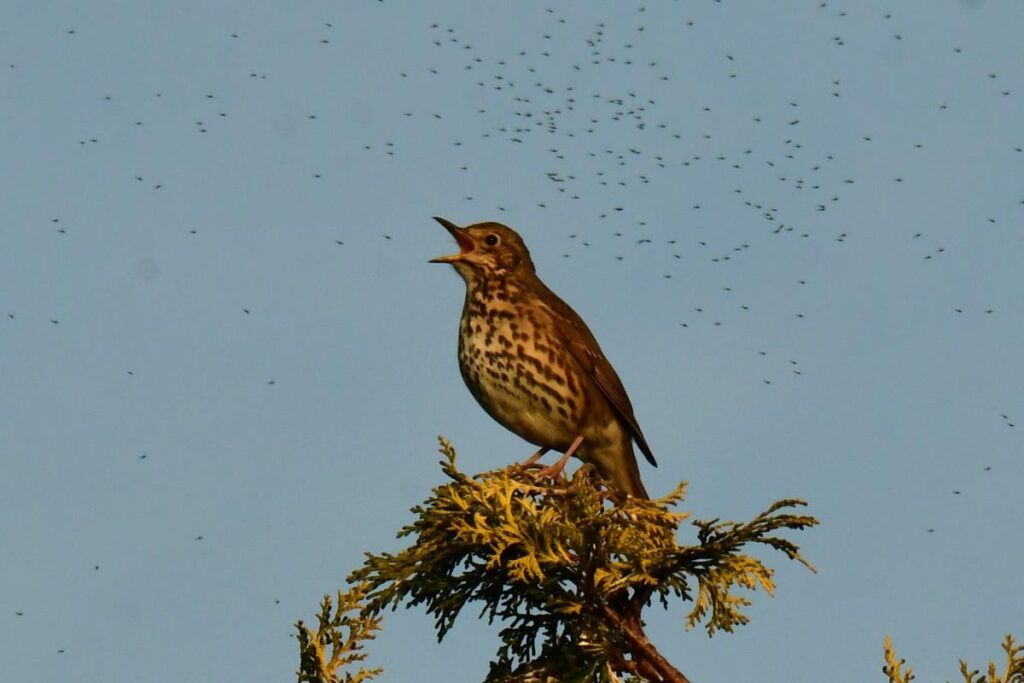
Something to listen for, and to listen to, in the coming weeks, as spring creeps in, is the sound of song thrushes. They are fairly common at Hogshaw with at least two territory-holding males near the playing field. In fact, we are holding one of two dawn chorus walks this spring, the earlier being on 28 March, when you will almost certainly hear them. It is not quite money back if you don’t but they are extremely reliable fixtures of dawn in this month. And we should be doubly proud of these local birds, because they are not common and are classified as an amber-listed species by the British Trust for Ornithology.
There are two breeding spotted thrushes in our area, mistle and song thrush. Both occur here. Both are essentially brown with copious spots across the whole of their buffy undersides. Yet the mistle thrush is much larger, paler and scarcer. There are only 165,000 pairs in Britain and for every one of them there are almost eight song thrushes. The latter is also smaller, darker, warm earthy-brown and the spots are denser with a warm buffy wash on the flanks.
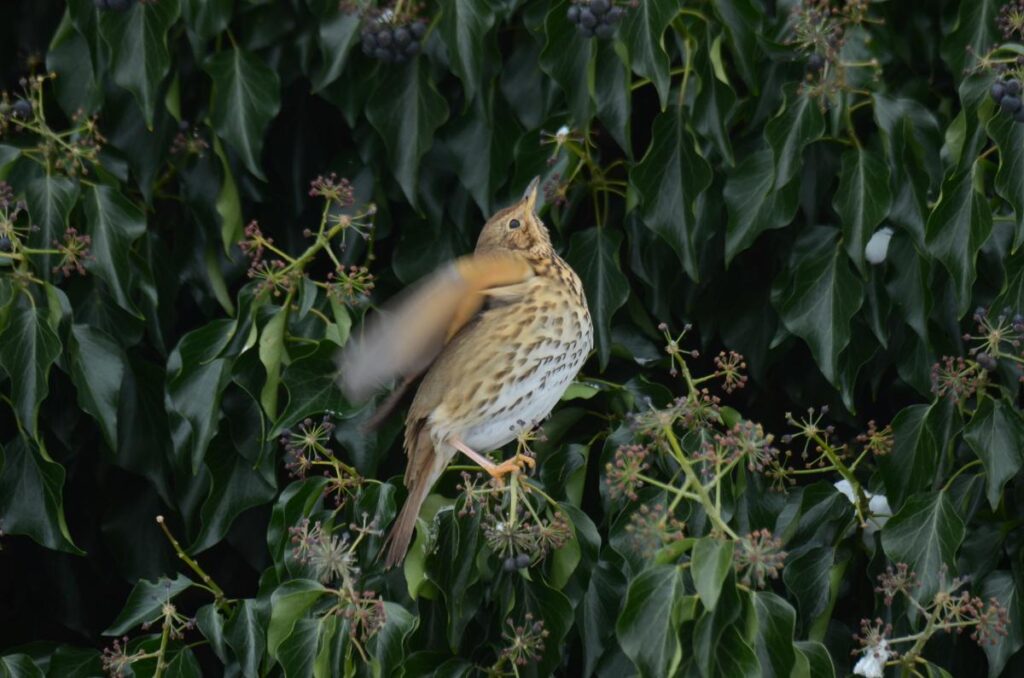
Mistle thrushes often sing in December and sometimes earlier and have a further reputation for relishing wind and rain when they sing, hence an old vernacular name ‘stormcock’. Mistle thrush song is a somewhat repetitive, high plaintive carolling that is often delivered from the top of a tall tree. The elevated song post somehow reinforces a sense of some remote quality in its voice, as if the bird were singing to itself.
Song thrush, on the other hand, has a feisty, immediate, intense and combative song that is brimful of hope. No British bird in fact, is more able to convey a sense of Panglossian optimism than a song thrush. The performance comprises a series of duplicated phrases – diddit, diddit, pichieu pichieu etc etc – that often contain snatches of mimicry of other species. It is delivered with almost physical force and as these repeat rounds pound out over the country like mortar fire, the listener can feel bombarded by a sense of well-being. It is joyous and uplifting and if you are feeling down because of the news, I prescribe ten minutes of song thrush as the perfect cure for most ills.
Mark Cocker, author and naturalist
email: [email protected] website: www.markcocker.com