
As you approach Hogshaw Nature Reserve from Hogshaw Villas Road and you cross the bridge, you will see a mature Alder tree on the riverbank to the right.
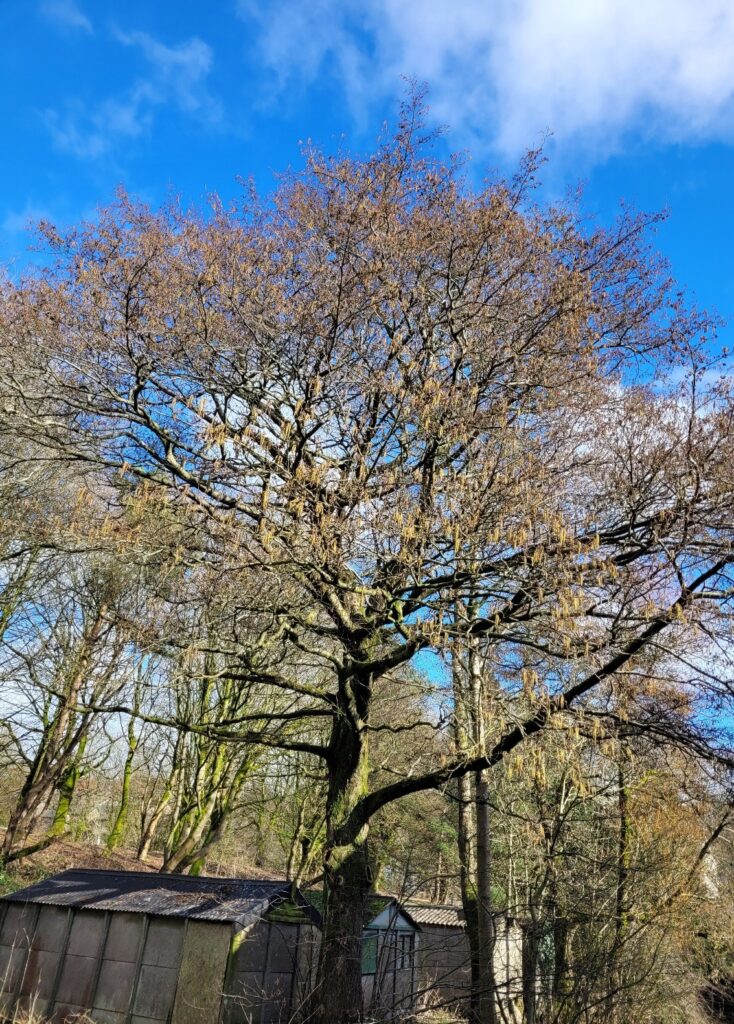
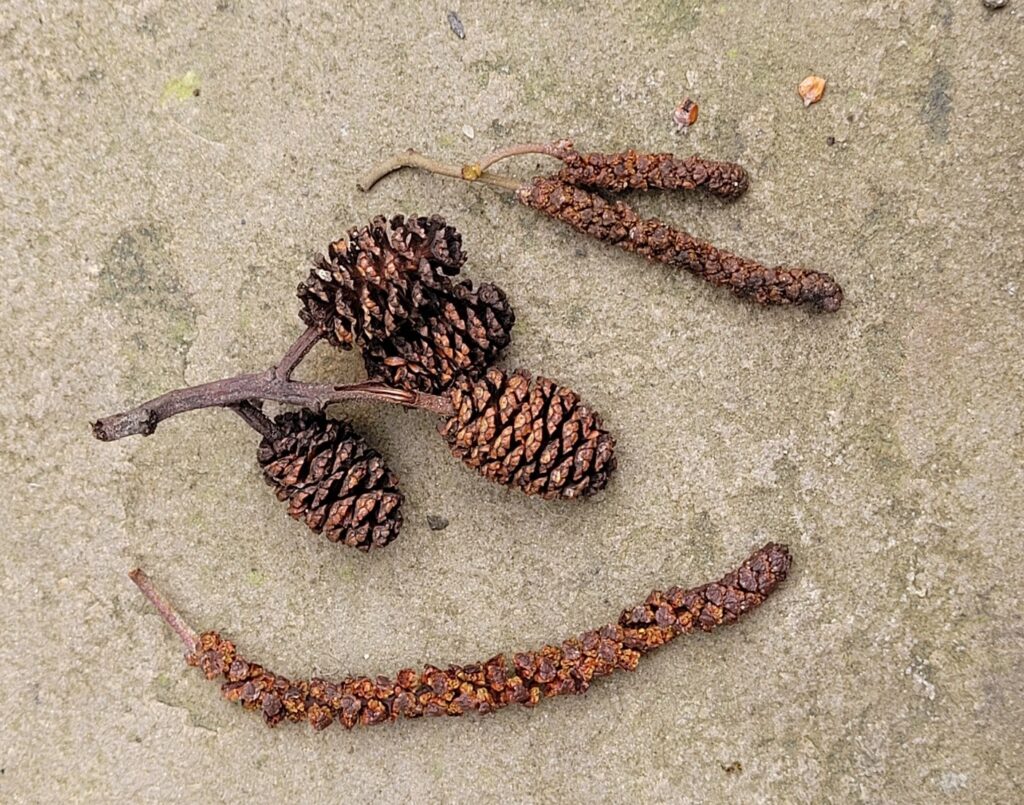
You can identify an Alder (Alnus glutinosa) easily, especially in winter, when its catkins are more visible. It has two types of Catkins from the male and female flowers of the tree. The male catkins being long and pendulous! The female catkins forming oval cone shapes, from the flowers that emerge in spring.
The alder is a tree that finds its place between water and land, preferring its roots in water. They often occupy these transitional places, beside rivers, streams and wetlands, where many other trees may struggle to grow. Glennie Kindred (1995) describes the alder as a tree of thresholds – places where one world meets another. Hogshaw is honoured to have this magnificent tree as the guardian of its gateway.
The Alder tree was associated by the Celts with the time around Spring equinox – between March 18th and April 14th. Spring equinox is a time of balance between day and night, light and dark, masculine and feminine, earth and water. The alder is a reminder that healthy landscapes require balance, between water and land, between fire and earth and between nature and people. The wood of the tree, when cut turns red, with the catkins and new shoots also being red/brown – which is seen as a representation of the element of fire. The fiery energy of the tree is balanced by the cooling connection with its watery roots.
The alder at the Spring Equinox, can be used as focus point to reflect or meditate on this theme of balance. Where do you feel your life, your emotions, your plans, ideas, dreams are a little out of balance? Use the energy of the alder to find ways of restoring the right balance to move forward into the year with greater clarity, strength and determination.
The alder plays a key role in areas like Hogshaw. They are the river protectors, with roots stabilising the ground, binding the soil, preventing erosion when water levels rise and slowing down the movement of water during heavy rainfall. The alder is a living sponge, holding water in the ground and releasing it slowly back into the river system. A great flood defence!
It is no surprise that we have alder on the old town tip, as they are often the first trees to be able to establish themselves on reclaimed or damaged land. Along with the willow, they can help restore water management as well as stabilise the land again.
The Alder actively helps the land to recover by healing the soil. They have a unique form of photosynthesis that creates sugars which it trades with nitrogen fixing bacterium Frankia Alna, which grows in the alders root nodules. This nitrogen can then be made available to other plants and trees nearby, enabling them to grow stronger and healthier – all because of the alder. So when alders move in, a transformation of the land begins. They work hard and quick, having a short life span of about 60-100 years.
Next time you pass into Hogshaw Nature Reserve, take a moment to pause on the bridge and notice this magnificent alder by the riverbank – our quiet guardian, between the land and the water. May it, and it’s successors, continue to protect us and provide nourishment and support for all the wild things.
Jax Palmer, Co-Chair, Action for Hogshaw